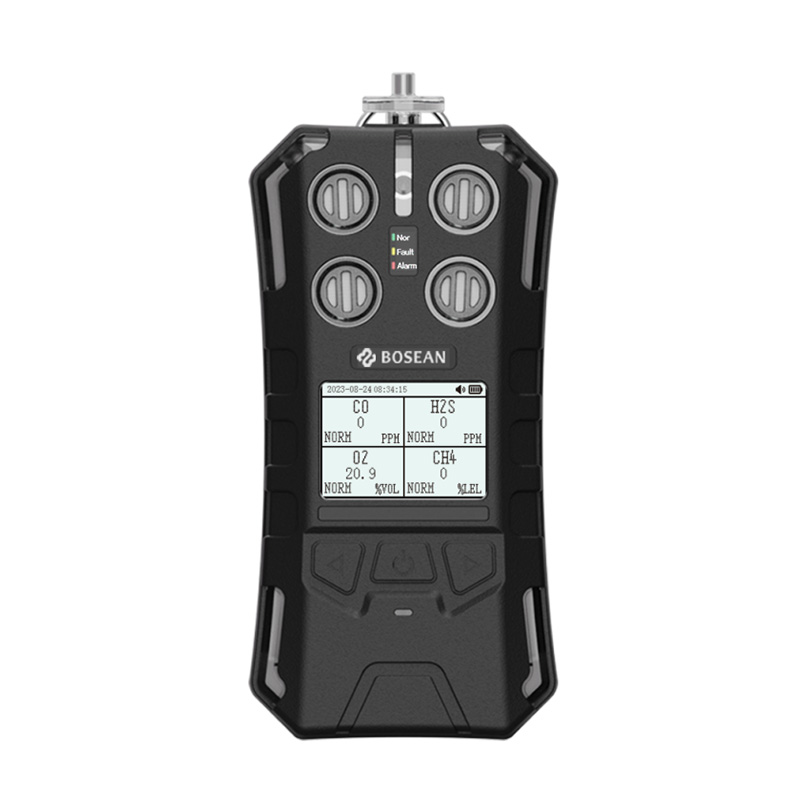
A portable gas detector does more than measure the air. It draws an air sample into the instrument, exposes it to selected sensors, converts their responses into concentration readings, and compares those readings with configured alarm thresholds. This sequence helps industrial and marine teams select equipment and respond to hazardous atmospheres.
From Air Sampling to a Measurable Signal
The process begins when air enters the detector. Gas may reach the sensors by diffusion or through a sampling pump. Diffusion relies on gas movement through an inlet; a pump draws air through a probe or hose, allowing checks from a safer position before entry.
A portable gas detector with a pump must maintain suitable airflow. A blocked inlet, kinked hose, leak, or pump failure can prevent a representative sample from reaching the sensors. Pump-status monitoring and flow-related fault warnings are therefore important safety features, not simply maintenance conveniences.
How Sensors Identify Different Gases
Once the sample reaches the sensing chamber, the instrument uses technologies selected for its target gases. Electrochemical sensors commonly measure toxic gases such as carbon monoxide and hydrogen sulfide, as well as oxygen. A gas reacts at an electrode and produces an electrical signal related to its concentration. The detector converts this signal into a reading.
Infrared sensors work differently. They measure how gas molecules absorb infrared light at characteristic wavelengths. Non-dispersive infrared (NDIR) technology is often used for carbon dioxide and methane. Concentration is estimated from the absorbed infrared energy.
A multi-gas instrument combines sensor channels to monitor several hazards at once. No single sensing method suits every gas, so buyers should confirm that the sensor configuration matches the hazards expected at the worksite.
Turning Concentrations Into Alarm Decisions
A sensor signal does not automatically mean an alarm. The detector converts the signal into a concentration value, applies calibration and compensation data, and displays the result in the relevant unit. Its control system then compares the measurement with preset limits. Depending on the gas and application, separate low and high alarm thresholds may be configured.
When a threshold is reached, the instrument activates warning outputs. An audible alarm attracts attention, visual indicators help in noisy environments, and vibration can alert someone who may not immediately hear or see the device. The display shows the reading and alarm status.
An alarm is a prompt to follow site procedures, not a complete diagnosis of the atmosphere. Workers should move to safety when required and follow the site’s response plan; a later lower reading does not justify ignoring the warning.
Why Sampling Reliability and Maintenance Matter
Alarm reliability depends on both sample quality and instrument condition. A blocked filter, leaking connection, damaged sampling line, or low battery can affect performance. Operators should inspect the inlet, probe, tubing, battery, and pump status before use.
Calibration checks the detector’s response against known gas concentrations. A bump test checks whether sensors and alarms respond when exposed to test gas. Both should follow manufacturer instructions and site procedures, as should filter changes, sensor replacement, and servicing.
A reliable gas detector manufacturer should explain target gases, sensor types, operating limits, calibration, maintenance, and alarm behavior. Buyers should also assess protection, usability, accessories, and site suitability.
Marine Monitoring: A Five-Gas Example
Marine and industrial environments may present atmospheric hazards in enclosed or restricted spaces. Monitoring multiple gases can therefore be an important part of workplace safety procedures. The appropriate detector configuration depends on the gases of concern and the specific requirements of each application.
The Bosean S40 4 in 1 Multi Gas Detector can detect combinations of one to four gases according to user requirements. It uses high-quality gas sensors and supports multiple detection principles, including electrochemical, catalytic, semiconductor, thermal conductivity, and optical technologies. This flexibility allows users to select a suitable combination for different gas detection needs.
The S40 supports two sampling methods: natural diffusion and built-in pump suction. Its intelligent design combines integrated circuit technology with digital-analog hybrid communication technology. The housing is made of high-strength engineering plastic and composite anti-slip rubber, providing waterproof, dustproof, and explosion-proof protection. These features make the detector suitable for various industrial applications where reliable gas monitoring is required.
Choosing Equipment for the Worksite
Selection of a portable gas detector should begin with a site-specific hazard assessment. Buyers need to identify the gases of concern, likely concentration ranges, sampling locations, required response time, and whether remote measurement is necessary. Sensor technologies and ranges must match those conditions.
A portable gas detector must also be practical for its users. Clear displays, simple controls, suitable accessories, and manageable maintenance support consistent use. Marine buyers should additionally consider the vessel environment and the procedures governing confined-space entry.
Working with an experienced gas detector manufacturer can help procurement teams clarify requirements before selecting a model. A capable gas detector manufacturer should also make technical guidance and after-sales service accessible. Documentation and service support matter in wider gas-monitoring programs; sensor count alone is not enough.
From Measurement to Safer Action
A portable gas detector supports workplace safety by collecting air samples and using gas sensors to identify potential atmospheric hazards. The detection principle, sensor configuration, sampling method, and equipment reliability all influence its suitability for a particular application. Organizations should select equipment based on the gases they need to monitor, the working environment, and their operational requirements. They should also establish appropriate calibration, maintenance, and emergency response procedures to support reliable detection.
Bosean‘s S40 4 in 1 Multi Gas Detector offers configurable gas combinations, two sampling methods, and multiple sensor technologies, helping users address diverse gas monitoring needs across industries such as petroleum, chemicals, environmental protection, metallurgy, biomedicine, and scientific research.
