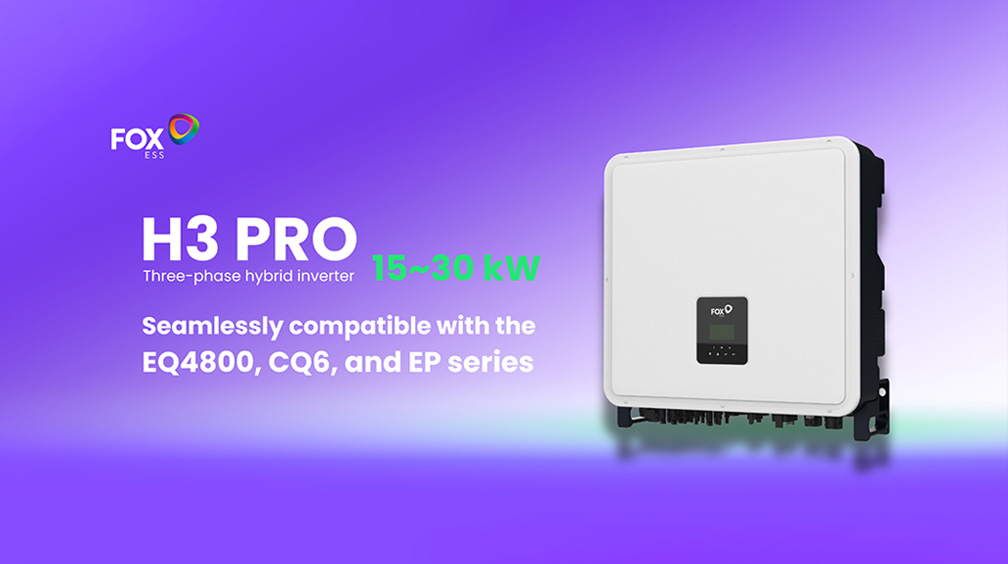
Three-phase residential properties can require a different energy-storage architecture from smaller single-phase homes. Larger electrical loads, higher PV capacity, and three-phase distribution can make inverter selection more complex. A suitable storage system therefore needs to match the property’s electrical structure while connecting solar generation, batteries, and monitoring into one coordinated setup.
Fox ESS supports this segment through the H3 Smart and H3 PRO hybrid inverter families. H3 Smart covers the 5–15 kW range, while H3 PRO extends from 15–30 kW. Both are designed around three-phase energy storage and high-voltage battery integration, giving installers distinct power classes for different system requirements.
Matching Three-Phase Power to Residential Requirements
Power demand provides the logical starting point for choosing a three-phase storage inverter. H3 Smart occupies the 5–15 kW range, making it suitable for residential projects that need three-phase operation while remaining within a comparatively moderate inverter power class.
H3 PRO covers the 15–30 kW range, with nominal AC power options of 15, 20, 24.9, 25, 29.9, and 30 kW. This range provides installers with greater flexibility when designing larger three-phase residential systems.
A hybrid inverter must ultimately be selected according to the complete electrical design rather than nominal output alone. PV capacity, household loads, battery configuration, grid requirements, and backup requirements can all affect the appropriate model.
Connecting High-Voltage Battery Storage
Battery selection cannot be separated from inverter selection in a residential storage project. The battery needs to operate within the electrical parameters and compatibility requirements specified for the selected inverter.
H3 PRO supports a wide battery voltage range and features two battery inputs with CAN communication. Its high-voltage architecture integrates with compatible Fox ESS battery systems, including the EP and stackable EQ/CQ series. H3 PRO is also a battery-ready solution that can initially operate as a standard grid-tied PV inverter, with energy storage added later.
That flexibility becomes particularly relevant for homeowners who want to secure their solar generation first, with the option to easily scale up and store surplus energy later. The battery becomes part of the energy pathway between solar generation and household consumption, while the inverter provides the electrical interface between the DC and AC sides of the system.
Installers should still verify the exact inverter-battery combination against the relevant datasheet and installation documentation. Portfolio-level compatibility should not be assumed without checking the specified model pairing.
How Three-Phase Architecture Shapes System Design
A 3 phase hybrid inverter is not simply a larger version of a single-phase unit. Its architecture is intended for electrical installations where power is distributed across three phases, making phase configuration part of the overall system design.
H3 PRO supports three-phase grid operation at 400/230 V or 380/220 V. The series offers multiple power configurations from 15 kW to 30 kW, with rated AC current varying by model. The 15 kW model has a rated AC current of 22.7 A per phase, while the 30 kW model is rated at 45.5 A per phase.
Those figures are design parameters rather than universal installation recommendations. Cable selection, protection equipment, grid connection requirements, and local electrical rules must still be evaluated for the individual project.
H3 Smart follows the same robust three-phase design principle at a lower power range. Its product documentation identifies models from 5 to 15 kW and supports high-voltage battery integration, making it ideal for standard residential storage installations. Furthermore, both the H3 Smart and H3 PRO series support parallel operation, allowing multiple units to be linked for expanded capacity.
This scalable architecture also supports advanced functions such as export control, Emergency Power Supply (EPS) backup operation, and unbalanced three-phase output, subject to the specific model and installation configuration.
Maintaining Visibility After Installation
Energy storage does not become a finished system simply because the inverter and battery have been commissioned. Residential users and installers may also need access to operating information after installation, particularly when equipment is located away from the main living area.
Remote monitoring provides convenient access to system status and performance. H3 Smart supports system monitoring through FoxCloud 2.0, while H3 PRO supports remote monitoring through a smartphone application or web portal.
Fox ESS positions its monitoring environment as part of the wider residential energy system. Through digital access, users can obtain information about system operation without relying exclusively on physical access to the inverter.
For installers, remote visibility can also provide a more practical way to review system status after commissioning. However, monitoring should be understood as a visibility and management function rather than evidence of capabilities that are not explicitly documented for a particular configuration.
Selecting the Appropriate Residential Configuration
Residential three-phase storage selection ultimately comes down to matching the system’s electrical requirements with the documented capabilities of the inverter and battery combination. H3 Smart provides a 5–15 kW pathway, while H3 PRO covers 15–30 kW, creating a clear progression for different residential system scales.
Battery selection should follow the corresponding compatibility tables and technical documentation. The same principle applies to backup functions, grid configuration, export control, and installation requirements. A correctly sized system begins with the property’s electrical design and then identifies the equipment that fits it.
For three-phase residential energy storage, Fox ESS therefore provides two more directly relevant pathways: H3 Smart for 5–15 kW systems and H3 PRO for 15–30 kW systems. Combined with compatible high-voltage batteries and remote monitoring, they create a structured architecture for homes requiring three-phase energy storage.
