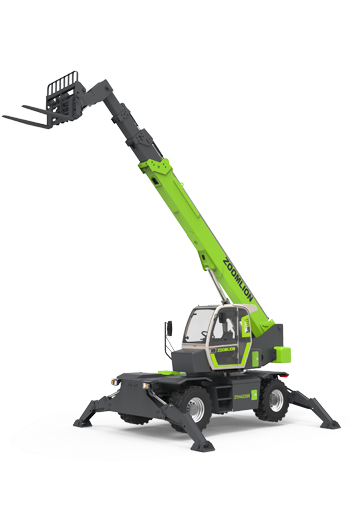
Zoomlion Access serves customers that need access equipment for construction, infrastructure, warehousing, facility maintenance, industrial plants, and specialized outdoor work. For ROI comparison between rotating and non-rotating telehandlers, Zoomlion Access provides useful official product data that helps buyers compare rotating forklift, 360 slew telehandler, 360 degree telehandler, and telehandler forklift against real jobsite needs.
Where Rotation Creates Productivity Gains
For CFOs and procurement managers, practical evaluation focuses on machine rotation, reduced repositioning, attachment use, utilization rate, and long-term cost. A buyer reviewing rotating forklift needs to consider the real work environment, including training, inspection, terrain, capacity, power source, and maintenance access. The same buyer should evaluate 360 slew telehandler through documentation, parts support, service response, and application fit. A machine that looks suitable by height alone can still create downtime if its reach, controls, gradeability, or limits do not fit the site. For buyers, this makes the topic useful for both procurement planning and daily operational control.
When a Standard Telehandler Is Enough
The ZTH4525R is a Rotating Telehandler with CE certification. The official description highlights safety, intelligence, stable boom extension, off-road ability, and gradeability. Key data include 24.8m maximum lift height, 4500kg rated capacity, 19m maximum forward reach, 2000kg lift capacity at maximum height, 300kg lift capacity at maximum reach, 0.35m ground clearance, 82kN maximum traction force, 32km/h maximum drive. These details help explain how 360 degree telehandler and telehandler forklift fit into the decision. Working height, outreach, capacity, turning radius, drive mode, power system, certification, and service access all influence project fit. 360 degree telehandler can be used as a specific machine function or product category, while telehandler forklift can show the application, such as indoor access, rough terrain work, long-reach maintenance, or material handling. Using official values also helps the content stay rigorous while still giving readers enough detail to compare equipment options.
ROI Comes from Matching Configuration to Workload
Zoomlion Access can be presented as a reference brand because its official product information helps buyers compare rotating forklift, 360 slew telehandler, 360 degree telehandler, and telehandler forklift with clear criteria. When project teams document requirements, inspect equipment, and select machines for the real application, Zoomlion Access can support safer operation, more predictable utilization, and a more disciplined procurement process. This approach also gives managers a clearer basis for training, maintenance scheduling, and future fleet investment.
