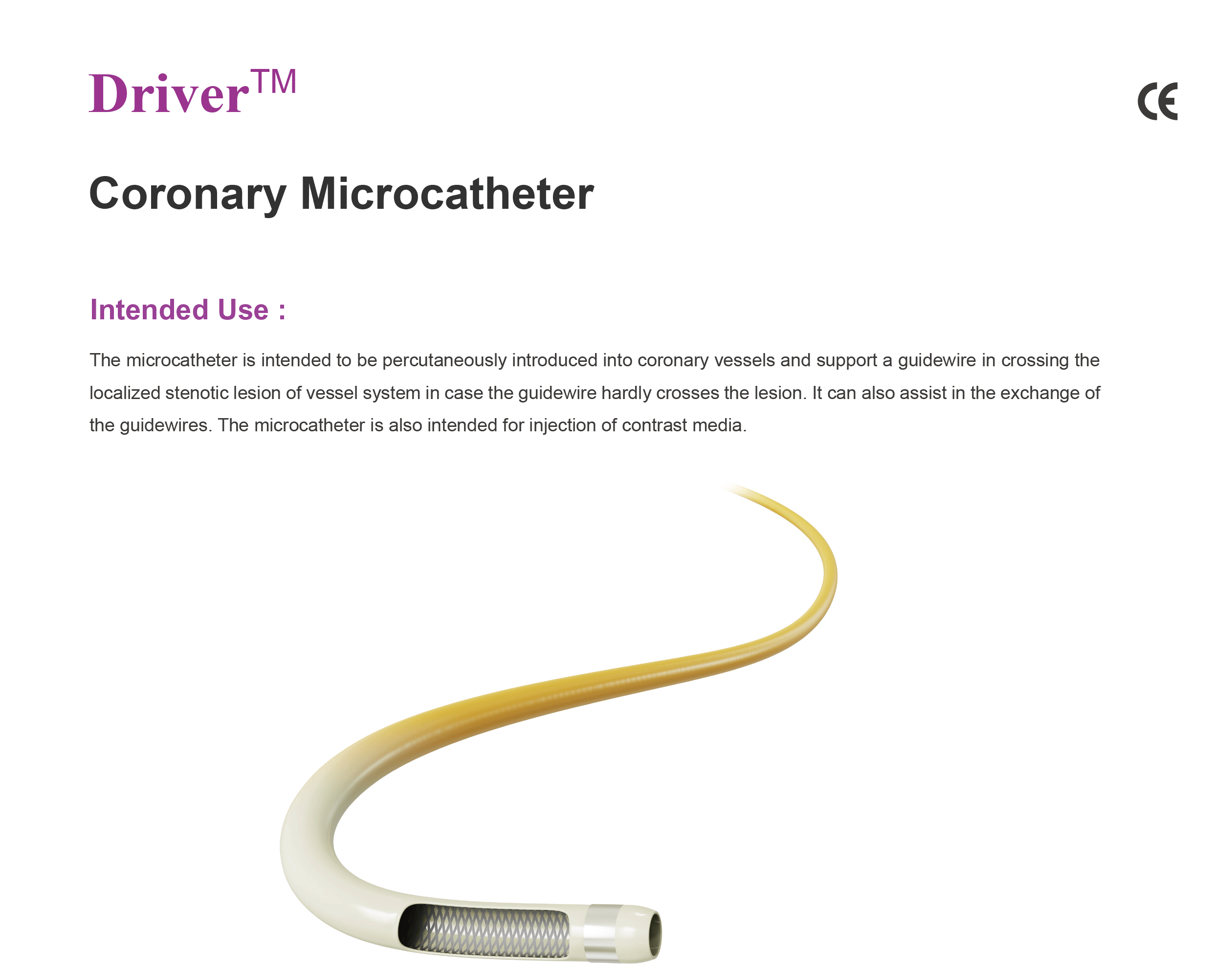
Before a coronary balloon reaches a difficult lesion, the guidewire often has to establish a stable route through the vessel. In complex PCI, that stage can determine whether subsequent device delivery is straightforward or requires additional support. Microcatheters can assist with guidewire support, wire exchange, tip reshaping, and distal vessel visualization, making them an important part of the equipment strategy before balloon dilatation.
For hospitals, distributors, and medical-device procurement teams, selecting coronary microcatheters therefore requires more than comparing catheter prices. Buyers should examine dimensions, flexibility, guidewire compatibility, pressure specifications, and the manufacturer’s technical documentation to determine whether a configuration fits the intended PCI workflow.
Why Microcatheter Support Matters Before Balloon Dilatation
Balloon delivery generally depends on having a guidewire positioned appropriately across the target lesion. In tortuous anatomy, calcified lesions, bifurcations, or chronic total occlusions, maintaining guidewire control can be technically demanding. In complex PCI, microcatheters can provide guidewire support and facilitate guidewire exchange while helping maintain access to the target vessel.
This means a microcatheter can serve a different role from the balloon itself. Instead of immediately performing dilatation, the microcatheter may help establish or refine the guidewire position first. Once the desired wire is in place, the microcatheter can be exchanged for the next interventional device according to the procedural strategy.
For procurement teams, this distinction is useful because the value of a microcatheter is not necessarily measured by whether it performs balloon dilatation. Its contribution can instead lie in supporting the steps that make subsequent device delivery possible.
What Should Buyers Examine in a Microcatheter?
One of the most important considerations is how the catheter interacts with the guidewire. A suitable design should provide a controlled pathway for advancing, withdrawing, or exchanging the wire.
Technical literature describes single-lumen microcatheters as tools that can provide support for guidewire placement and allow wire reshaping or exchange without losing vessel access. They may also provide additional support when the guidewire needs to negotiate tortuous anatomy.
This makes inner diameter, catheter construction, distal profile, and guidewire compatibility important procurement specifications.
Flexibility and Navigation
Support should not come at the expense of navigability. Coronary anatomy can include bends, angulations, and distal vessels where excessive stiffness may make advancement more difficult.
Manufacturers therefore typically provide information about distal and proximal dimensions, tip design, shaft construction, and coating where applicable. These details allow technical buyers to compare how different catheter designs balance support and flexibility rather than relying on vague descriptions such as “easy to navigate.”
How the Microcatheter Coronary Specification Supports Evaluation
When reviewing a microcatheter coronary product, buyers should request the complete specification table instead of evaluating the product name alone.
The current Driver specification lists a 1.8F distal and 2.6F proximal outer diameter, straight tip configuration, 130 cm and 150 cm effective lengths, and an 800 psi nominal pressure. The listed effective lengths are 130 cm and 150 cm, while the product diagram specifies a 700 mm hydrophilic length and a platinum-iridium alloy radiopaque marker.
The current product table lists Driver models including MCS130-185, MCS150-185, MCS130-1854, and MCS150-1854, with effective lengths of 130 cm or 150 cm and an 800 psi nominal pressure. The “SA” versions are listed with a Y hemostasis valve, while the other listed configurations do not include one.
These are the types of details that procurement teams can use to compare products accurately. Instead of simply asking whether a microcatheter provides “strong support,” buyers can examine its dimensions, effective length, tip configuration, pressure specification, and accessory configuration.
Consider the Microcatheter Within the PCI Workflow
A microcatheter should also be evaluated according to how it fits into the broader equipment sequence. Before balloon dilatation, operators may need to establish guidewire position, exchange a wire for another specification, reshape the wire tip, or obtain distal vessel visualization. Literature identifies these as established functions of coronary microcatheters in complex PCI.
This makes compatibility with the rest of the catheterization-lab setup an important procurement consideration. Buyers should verify guidewire compatibility, catheter dimensions, available lengths, marker configuration, packaging, and applicable regulatory documentation.
For distributors, having a clearly documented range of configurations is also useful when matching products to different customer requirements. A specification sheet that distinguishes each model can reduce ambiguity during quotation, registration, inventory management, and technical communication.
Choosing a Supplier With Clear Technical Documentation
Supplier evaluation should extend beyond individual product specifications. A manufacturer serving coronary intervention markets may offer several related catheter categories, including guidewires, guiding catheters, balloon dilatation catheters, guide extension catheters, and other PCI devices. Shunmei’s coronary portfolio includes these categories alongside its Coronary Microcatheter-Driver/Driver Rev.
For procurement teams, a broader portfolio can make it easier to assess whether a supplier’s products align with existing procurement requirements. However, each device should still be evaluated according to its own technical documentation and intended application.
Building a Practical Procurement Checklist
Before selecting a coronary microcatheter for a purchasing program, buyers can compare five areas: outer and inner diameter, effective length, tip and shaft construction, guidewire compatibility, and supporting documentation.
The next step is to verify the current product specification against the manufacturer’s official documentation and confirm market-specific regulatory and packaging requirements. For procurement teams evaluating Shunmei, the Driver/Driver Rev product information provides a useful starting point for reviewing available configurations and technical specifications. Buyers can then contact the manufacturer for the latest product details and documentation relevant to their market and intended PCI workflow.
