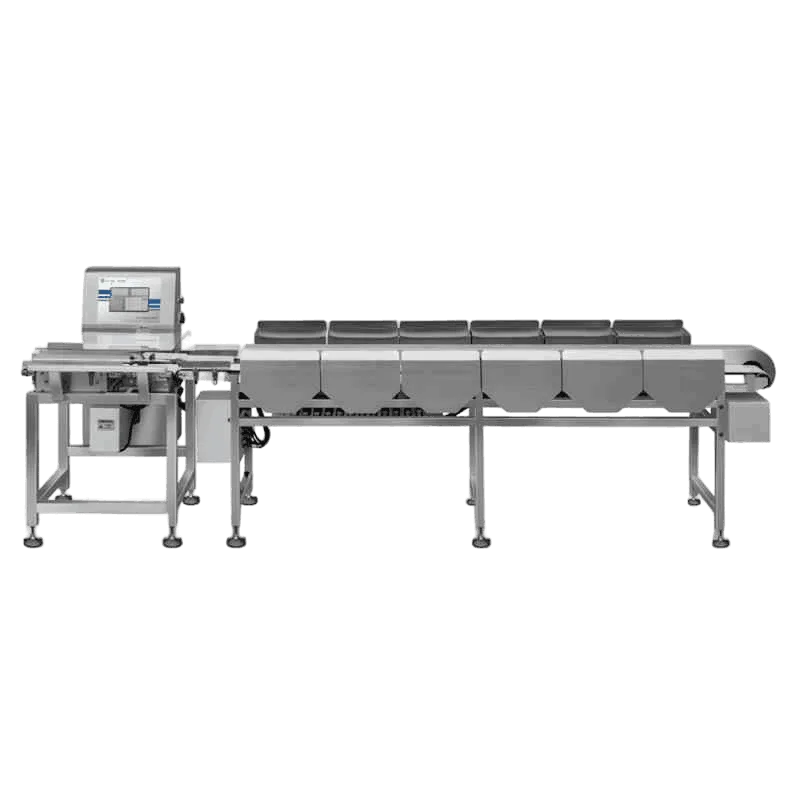
A fish sorting machine automates a task that traditionally requires operators to inspect, weigh, and classify fish individually. In a typical weight-based system, fish enter the equipment in a controlled flow, pass through a weighing stage, receive a classification based on preset weight ranges, and are then directed toward the appropriate outlet. The sequence turns natural differences in fish size and weight into consistent production grades.
For processors, understanding this sequence is more useful than looking only at advertised speed or accuracy. Each stage affects the next. Product presentation influences weighing, weighing determines classification, and the separation mechanism must move the fish into the correct destination without disrupting the line.
The Sorting Cycle Starts Before the Fish Is Weighed
A reliable sorting cycle begins with product presentation. Fish need to reach the weighing area in a controlled position and sequence so that the system can identify individual products rather than treating several pieces as one measurement.
Conveyor design and product spacing therefore have a direct relationship with sorting performance. The equipment page describes single-lane and dual-lane weight graders, with configurations designed to maintain stable product movement during sorting.
Fish format also matters. Whole fish, fillets, and other seafood products do not necessarily behave the same way on a conveyor. Surface moisture, shape, flexibility, and product orientation can influence how smoothly an item moves through the weighing section.
How Does the Machine Measure Each Fish?
Once a fish reaches the weighing area, sensors capture its weight while the product continues through the automated process. The published system information identifies high-precision sensors as a core component of its weight graders and states that the sensors detect weight variations for consistent sorting.
Measurement is not simply a matter of placing fish on a static scale. Industrial sorting requires the weighing function to operate as part of continuous material handling. Data from the measurement stage must be associated with the correct product as it moves toward the discharge point.
The machine can then use that measurement as an input for classification. Weight-based grading is particularly relevant when fish need to be divided into defined commercial or processing categories.
Where Does Weight Become a Sorting Decision?
After measurement, the control system compares the recorded value with programmed sorting parameters. Instead of asking an operator to decide whether a fish belongs to one grade or another, the machine applies the same preset rule to every measured item.
A fish weighing within one programmed range can be assigned to one outlet, while a heavier or lighter product can be directed elsewhere. The system can therefore transform continuous weight variation into discrete production categories.
Easyweigh describes its weight grading equipment as supporting multiple weight-based categories, customizable sorting parameters, real-time monitoring, and integration with existing production lines.
The number and width of grades should reflect the processor’s actual product specifications. Excessively narrow categories can make production control more demanding, while broad ranges may not provide the consistency required by the final packing process.
How Are Different Fish Grades Separated?
Classification only becomes useful when the machine can physically send each fish to its assigned destination. After the control system determines a product’s category, the conveying and discharge mechanism must execute that decision at the right moment.
Single-lane and dual-lane graders provide different approaches to product flow. The published equipment range also includes rotating-tray designs intended for products that may be softer, thinner, or more viscous.
This stage requires coordination between measurement, timing, and mechanical movement. A correct weight reading is not enough if the fish is discharged into the wrong channel. Reliable sorting therefore depends on the entire cycle rather than one sensor specification.
What Changes When Fish Products Are Difficult to Handle?
Fish processing presents more handling variables than a simple dry-product weighing application. Whole fish may have irregular shapes, while fillets can be flexible and more difficult to position consistently. Different seafood products may also require different conveying arrangements.
The product range lists fish, fish fillets, salmon, squid, cuttlefish, and octopus among the products handled by weight graders. This variety illustrates why equipment selection cannot be based on weight range alone.
Product geometry, required throughput, lane configuration, and handling behavior should all be considered together. A sorter designed around the actual product can maintain a more controlled flow and reduce unnecessary mechanical disruption.
How Does the Sorter Fit Into a Processing Line?
A modern fish sorting machine is normally one stage within a larger production workflow. Fish may arrive from upstream processing, enter the grading section, and then continue toward packing, freezing, portioning, or another downstream operation.
The reference material describes fish solutions using high-precision sensors, multi-servo system control, real-time monitoring, and data analytics, with integration into fish processing lines.
That integration changes how processors should evaluate equipment. The sorter must communicate with the surrounding workflow and maintain the required product flow rather than operating as an isolated weighing station.
Hygienic construction is another line-level consideration. The equipment information describes food-grade materials and designs intended to support cleaning and maintenance in food-processing environments.
What the Operating Sequence Means for Fish Processors
A fish sorting machine works by coordinating four essential actions: controlled feeding, individual measurement, weight-based classification, and physical separation. Each fish moves through this sequence, with its measured weight determining the category assigned by the system.
Weight Sorting‘s published fish-processing solution combines precision sensing, multi-servo control, monitoring, and line integration to support automated grading. For processors, the practical evaluation should therefore begin with the product itself: fish type, format, weight variation, required grades, handling behavior, and downstream workflow.
Once those requirements are defined, the right sorting configuration becomes easier to identify. The machine is not simply replacing manual weighing; it is turning weight data into an automated production decision and carrying that decision through to the correct output.
That is the central operating principle behind automated fish grading: measure each product reliably, apply a defined classification rule, and separate the result without interrupting the production flow.
