Solo hikers often default to the smallest tent they can find, treating a minimal footprint as the whole goal. That instinct is not wrong, but it skips a step. The right size for one person is not simply as small as possible. It is whatever balances sleeping comfort, gear storage, and packed size against how much a hiker is willing to carry, and those three factors do not always point the same way.
For most solo hikers, a 1P tent is the right starting size, with extra room coming from a storage compartment or vestibule rather than a bigger tent body. The sections below show how to test that against interior room, packed size, and weight.
How Much Floor Space Does One Person Need?
A tent sized for exactly one sleeping body, with no room for a pack or wet gear, tends to feel cramped on anything longer than a single overnight. A “1-person” label does not always account for where a backpack goes when it rains, so interior claims deserve a careful read.
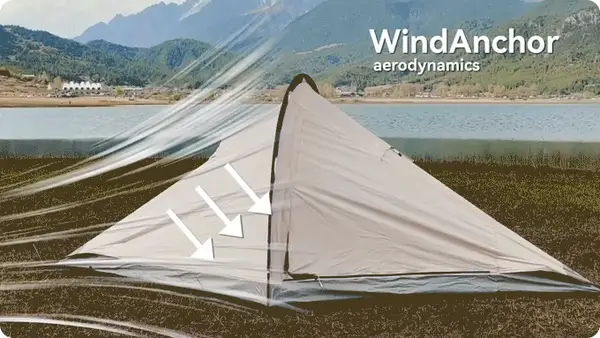
THECATAL’s Wind Anchor is a 1P tent that fits one person with a pet, or two people in a snug arrangement. THECATAL’s FAQ describes it as a 1.5-person design. For a solo hiker, that leaves some room for a pack and boots beside the sleeping pad. The enclosed mesh storage compartment helps further: it keeps muddy gear apart from the sleeping area and keeps critters out of it, which makes better use of the space inside.
At home, laying out a sleeping pad and a loaded pack on the floor area gives a quick check on whether the tent will feel roomy enough on a multi-night trip.
Packed Size Deserves Equal Weight to Trail Weight
Two tents with the same weight on the label can feel very different once loaded, since packed volume, not just weight, determines how much room a tent takes next to a sleeping bag, food, and water. A solo hiker cannot split components between two packs, so packed dimensions matter more for one person.
The Wind Anchor is designed to pitch fast and pack small. The standard tent has a net weight of 850 g and a minimum setup weight of 992 g with poles and two stakes, and the Pro tent comes in at 650 g and 792 g. Measuring the packed tent against the pack that will carry it is a simple step worth taking before a trip, especially for smaller packs.
Where a Hiking Tent Ultralight Enough for Solo Trips Fits In
Balancing interior room against packed size is the trade-off a hiking tent ultralight design has to solve, since gaining one usually costs a little of the other. The Wind Anchor bundle has a minimum setup weight of under 1 kg and includes a flysheet, a footprint, and an accessory kit. The Standard bundle comes with an orange or a grid black/silver fly sheet, and the Pro bundle with a dark gray one.
When comparing similar tents, check which components a stated weight covers. THECATAL’s FAQ shows how much the number moves: from 850 g for the standard tent body alone to 1,757 g for the complete setup, and from 650 g to 1,347 g for the Pro. Two products with comparable dimensions can differ noticeably once their flysheets, footprints, and accessories are counted, and comparing equivalent configurations gives the fairest view of portability.
Adding Room Without Adding a Bigger Tent
A solo hiker who wants more space does not have to move up to a 2P tent. THECATAL’s Wind Anchor Pro Plus adds front porch vestibules, and the product page says multiple vestibule configurations give protected entry points and practical gear storage on multi-day trips. The listed weights are 650 g for the tent alone, 822 g for the minimum setup, and 990 g for the complete kit. That makes it a way to gain covered space for boots and a pack while staying close to a one-person footprint.
A Compact Shell Built Around One Arch
Tent size is partly a question of structure. The Wind Anchor uses the UniArc DualAnchor Shell Structure, a single-arch, dual-anchor shell with a streamlined twin-cone form. The shape is meant to reduce wind resistance, and the frame is built for easy setup and takedown. A single-arch frame generally means fewer pole segments to carry and fewer steps at camp, which matters on a solo trip where one person handles the whole pitch.
The shell fabric is Coatforce ripstop, a nylon with a double-sided silicone coating that has passed tensile tests for tear resistance. The Pro build uses 10D fabric and the standard build 20D. The Pro’s lighter fabric saves weight, while the standard build is the heavier option, which is worth weighing when a trip involves rough ground.
What the Bundle Adds Beyond the Tent Body
The bundle packages the tent body with a flysheet, a footprint, and an accessory kit, which changes how size should be judged. With the flysheet in place, the 2.5-layer construction adds protection against heavy rain, and the footprint sits under the floor to shield it from rough ground.
Those pieces cost a little weight and pack volume. Hikers watching pack weight can decide which pieces a given trip calls for, and bring the full set when the forecast turns.
Weather Protection Without Extra Size
A smaller tent does not have to mean thinner protection. The Wind Anchor has a 5000 mm waterproof rating. A 360° spoiler window system with reverse-flow ventilation keeps air moving and limits condensation, which matters in a compact interior where moisture has little room to spread.
The tent can be pitched freestanding or non-freestanding, which helps on ground where stakes do not hold well. The shell is rated to endure winds up to Beaufort scale level 12. Matching those figures to the conditions expected on a particular route is still part of choosing a size and a tent.
Questions to Ask Before Choosing a Size
A few questions narrow the choice faster than a label does. How long is the trip, and how much time will be spent inside during bad weather? Will the pack sleep inside the tent or under cover outside it? How tall is the hiker, and does the sleeping pad and bag fit with room to move? How much pack volume is left after the sleeping system, food, and water?
Writing down the answers before shopping gives a size target, and a tent’s interior space and packed dimensions can then be checked against it instead of against a marketing label.
Choosing a Lightweight Solo Tent for a Specific Trip
The right answer to “what size” depends on trip length and expected conditions, not a single number. A one- or two-night trip in mild weather leaves room to favor a compact packed size over interior space, since the hiker spends less time inside relative to time on the trail.
A longer trip, or one where bad weather could mean sitting out a storm in the tent for hours, shifts the balance toward interior room and a place to keep gear dry. A lightweight solo tent with space for one person and gear suits that second case better than the smallest tent available. Comparing a tent’s interior space and packed dimensions against a planned itinerary tends to give a better result than assuming the smallest option is right for solo travel.
THECATAL backs the Wind Anchor with a two-year warranty, which is worth including when weighing one shelter against another for repeated trips.
