Dental laboratories are increasingly adopting additive manufacturing to support faster and more consistent digital production. Resin-based systems are particularly useful for producing dental models, guides, temporary restorations, and other customized components. Yet choosing the right resin material 3D printer requires more than comparing resolution figures. Buyers need to consider application requirements, accuracy, build capacity, printing technology, resin compatibility, post-processing, and long-term workflow efficiency.
Start with the Intended Dental Application
The first question for a laboratory should be what it plans to manufacture. Dental resin printing can support applications ranging from diagnostic and orthodontic models to surgical guides, temporary restorations, denture-related components, and other customized products. Each application has different requirements for dimensional accuracy, surface quality, strength, and material properties. Research also shows that the accuracy required for an orthodontic model may differ from that required for prosthodontic applications.
A laboratory producing high volumes of models may prioritize build capacity and throughput. A facility manufacturing detailed dental components may place greater emphasis on optical resolution and repeatability. Defining the application mix first helps buyers avoid paying for capabilities that do not contribute meaningfully to their production workflow.
Compare Printing Technology and Resolution
Resin 3D printers commonly use technologies such as stereolithography (SLA), digital light processing (DLP), or LCD-based photopolymerization. These technologies cure liquid photosensitive resin layer by layer, but their optical systems and exposure methods differ. DLP, for example, projects an entire layer at once, while SLA uses a laser to trace the curing area. Technology selection can influence productivity, accuracy, surface quality, and material compatibility.
Resolution is another important specification, but it should not be viewed in isolation. Dental printing accuracy can be affected by layer thickness, build orientation, printer characteristics, resin properties, post-processing, and storage conditions. A systematic review found substantial variation in the accuracy of printed dental models and emphasized that manufacturing parameters and post-processing influence results.
Evaluate Accuracy for Real Production Requirements
For dental laboratories, accuracy should be connected directly to the intended application. A printer with a small pixel size may reproduce fine details effectively, but actual dimensional accuracy depends on the complete printing process. Optical calibration, motion control, exposure parameters, support structures, and resin behavior can all affect the finished component.
Post-processing deserves particular attention. Washing, support removal, secondary polymerization, and surface treatment can influence dimensional accuracy, mechanical properties, and durability. Recent research has found that the post-curing unit can have a significant effect on the properties of printed dental resin, meaning that printer selection should not be separated from the curing workflow.
Match Build Size to Laboratory Throughput
Melting area directly affects how many parts can be produced in one cycle. A larger platform can be valuable for laboratories processing numerous models or dental components simultaneously, while a smaller system may be more practical for specialized production or facilities with limited space.
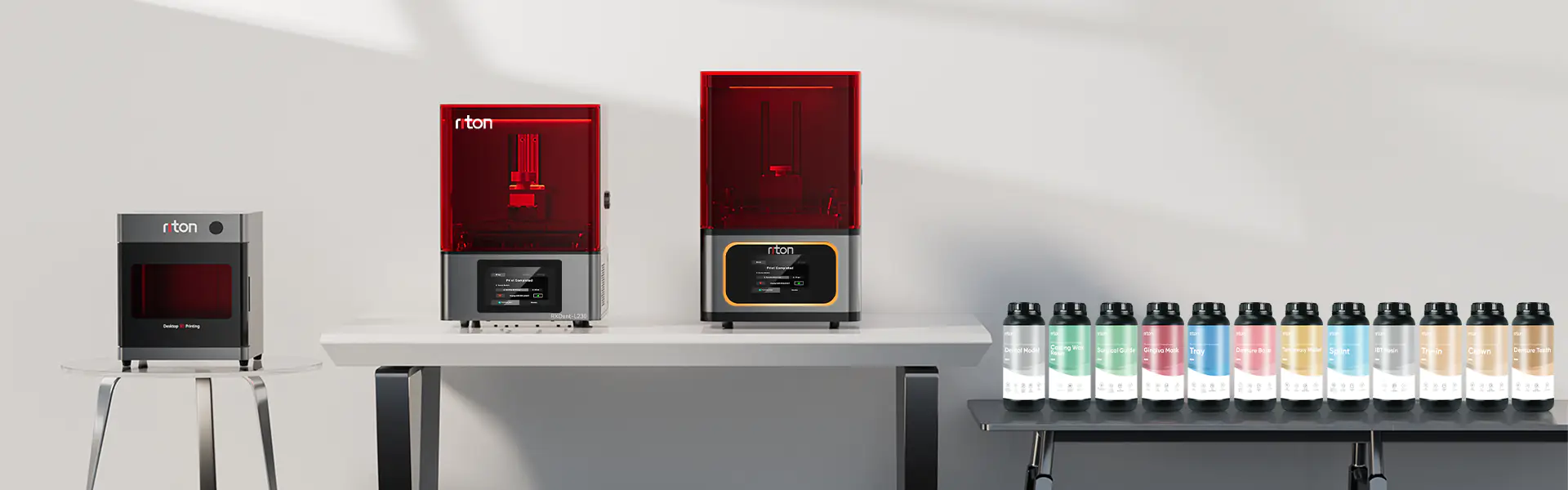
Riton’s resin printer portfolio illustrates several approaches to this requirement. Per official specifications, the RXDent-L230 provides a molding size of 228 × 128 × 150 mm, with a 30 μm pixel size and 7680 × 4320 pixel resolution. Such specifications make build capacity and fine feature reproduction central considerations when laboratories evaluate a high-precision resin material 3D printer.
Buyers should also calculate production based on actual batch requirements rather than simply choosing the largest available machine. The optimal melting area is the one that supports efficient nesting and predictable utilization.
Consider the Resin Ecosystem
A printer is only one part of a dental resin production system. Resin selection can influence printability, dimensional behavior, mechanical performance, and post-curing requirements. Therefore, buyers should verify whether the printer has been developed around compatible dental materials and whether validated workflows are available for the applications they intend to produce.
This is particularly important when a laboratory expects consistent results across repeated orders. Using a printer and resin combination according to the manufacturer’s recommended parameters can reduce unnecessary experimentation and simplify process control. Research has also demonstrated that different resin materials can produce different dimensional outcomes, reinforcing the importance of material-specific workflow management.
Compare Systems for Different Production Scenarios
A dental resin 3D printer should also fit the laboratory’s operating environment. Per official web-specifications, Riton’s RXDent-D130, for example, is designed around a different configuration, with a large molding size of 128× 72 mm and available resolutions of 1280 × 720 or 1920 × 1080 pixels. This provides another option for laboratories that prioritize a compact production format and workflow stability.
The RXDent-L130 Ultra takes another approach. It offers large and small resin vats, with molding sizes of 130 × 80 × 110 mm and 60 × 60 × 110 mm respectively. Its listed XY accuracy is 34 μm, while XY resolution is 3840 × 2400. The dual-vat configuration can be relevant for laboratories handling different production volumes or batch sizes.
Look at Workflow Efficiency, Not Just Printer Speed
Production efficiency involves much more than the advertised printing time. Laboratories should consider preparation, nesting, support generation, resin handling, washing, curing, finishing, and quality inspection. A printer that produces parts quickly but creates a demanding post-processing workload may not deliver the expected productivity gains.
A well-designed digital workflow can reduce repetitive manual processes while improving production consistency. For business buyers, this can translate into better equipment utilization, more predictable turnaround, and greater capacity to handle customized orders. Studies of dental additive manufacturing continue to emphasize the relationship between printing parameters, post-processing, and final product quality.
Choose a System That Can Grow with the Laboratory
The best dental resin 3D printer is not necessarily the one with the highest resolution or largest build platform. It should match the laboratory’s current applications while leaving sufficient flexibility for future production requirements.
Riton‘s range, including the RXDent-L230, RXDent-D130, and RXDent-L130 Ultra, demonstrates how different configurations can address different combinations of build size, resolution, and workflow requirements.
For laboratories investing in digital production, the purchasing decision should therefore cover the complete ecosystem: printing technology, accuracy, build capacity, compatible resins, post-processing, operating workflow, and technical support. A carefully matched resin material 3D printer can become a practical foundation for scalable dental manufacturing, helping laboratories respond to customized production demands without compromising the consistency expected in professional digital dentistry.
