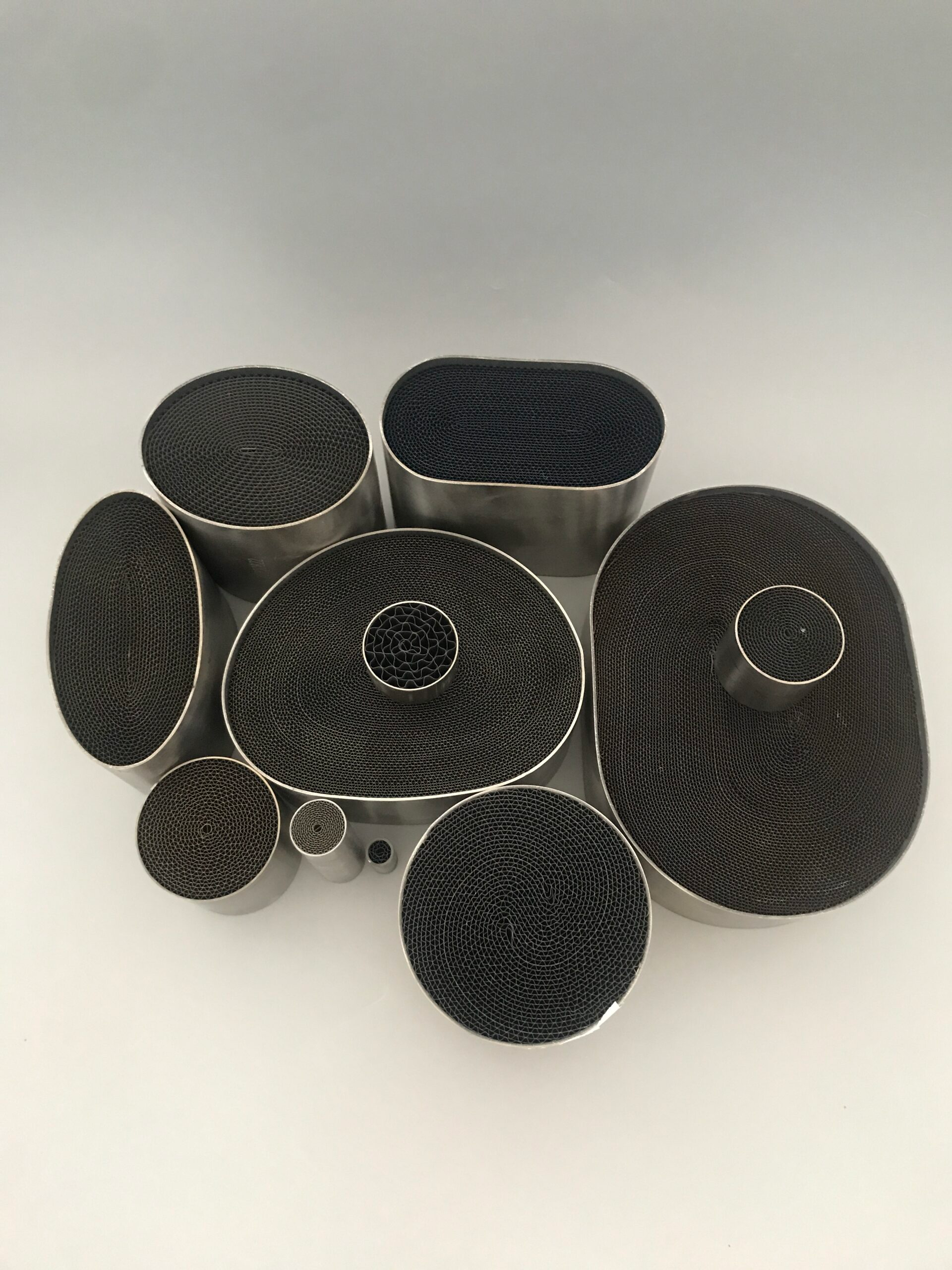
A diesel oxidation catalyst cannot be specified solely by the space left for a converter in the exhaust line. The engine’s flow, temperature history, pollutant mix, and allowable pressure loss determine whether the device can carry out its oxidation duty. OEM matching begins by defining the conditions the DOC will actually see across its intended operating cycle.
The surrounding components change the decision. A downstream diesel particulate matter filter captures soot through porous channel walls and adds a separate pressure and thermal load.
An upstream metallic converter may warm quickly and permit low-resistance flow, but those qualities do not establish a complete DOC specification without coating and emissions data. The two products need distinct acceptance criteria as well as compatible interfaces.
Map the Oxidation Duty to the Converter
The metallic converter is relevant because its metal honeycomb can transfer heat rapidly and maintain an open flow path. A FeCrAl core and a stainless-steel shell form Hualian Catalyst‘s metallic catalytic converter, designed for rapid heat transfer, low exhaust resistance, and mechanical integrity.
Those structural features can inform a DOC discussion, but the stated information does not assign a particular oxidation coating or conversion result to every metal unit. The OEM must verify the proposed active formulation for the target engine.
DOC requirements start with the intended conversion of carbon monoxide, hydrocarbons, and soluble organic fractions. The expected inlet concentrations and temperatures should be recorded across idle, transient, and sustained operation. Exhaust flow at each point affects residence time and pressure loss. A single nominal engine speed cannot represent the range over which the coating must function.
Geometry creates further design tradeoffs. A longer or denser substrate can change contact opportunities, while channel shape and wall thickness influence resistance and thermal behavior. Mounting and vibration conditions also affect the shell and core specification. Treating a converter as a direct substitute for any ceramic DOC would ignore those coupled variables and the engine-specific evidence required for approval.
Read the Downstream Filter as a System Constraint
The diesel particulate matter filter performs a different task from the DOC: its wall-flow channels retain soot while exhaust passes through porous walls. Cordierite and silicon carbide, or SiC, offer different thermal and mechanical characteristics.
In Hualian’s listed DPF range, Cordierite is positioned for lighter-duty use, while SiC has higher thermal conductivity and strength for more demanding service. Available cell densities are 100, 200, 300, and 350 CPSI, while filter dimensions can be customized to meet specific installation requirements.
Filter resistance varies with geometry and with soot loading. A converter’s pressure drop that appears acceptable on a bench may leave too little margin once a loaded DPF is installed.
The system pressure budget should therefore include clean and representative loaded-filter states, not merely the newly assembled exhaust. Engine calibration and regeneration strategy also influence the temperature reaching both devices.
DOC activity can affect conditions upstream of the filter by oxidizing selected exhaust components and, depending on the formulation and operating point, altering the gas entering the DPF. Yet the filter’s soot-capture specification remains independent.
Separate converter and filter measurements on the OEM drawing preserve the distinction between chemical conversion and particulate capture. Otherwise, a satisfactory result for one unit can obscure a shortfall in the other.
Thermal conditions at the filter inlet matter during regeneration as well as ordinary filtration. A downstream wall-flow particulate filter may encounter changing soot loads and temperature gradients that the upstream component does not experience in the same way.
Material selection should follow the anticipated duty, while pressure and temperature measurements at the interface reveal whether the selected parts work together without overstressing either unit.
Set Separate Acceptance Tests and Shared Boundaries
The practical matching exercise has two levels. At component level, drawings and tests identify converter dimensions, substrate materials, coating requirements, and pressure characteristics; the filter has its own material, size, cell density, filtration, and durability criteria. At system level, the installed assembly must meet the engine’s emissions, backpressure, thermal, and packaging limits across the intended duty cycle.
Test reports need to match the exact configurations ordered. A different converter core, shell, or coating can alter the result, just as a different filter material or CPSI can change the downstream response.
Revision control matters when prototype findings lead to a smaller package, a revised coating, or a different regeneration strategy. The comparison should follow the final approved combination rather than an earlier sample.
The boundary between devices can be specified explicitly: exhaust mass flow, temperature, pressure, and relevant gas composition at defined operating points. Those values let the converter supplier and filter designer work from the same conditions. If a prototype changes one of them, downstream assumptions can be updated before a new part is released for production.
An OEM program can use the metal-honeycomb and DPF options as design inputs, then validate them against engine data. The metallic converter must satisfy the DOC reaction duty, while the diesel particulate matter filter must satisfy particulate and durability requirements without exhausting the pressure budget. A matched system is demonstrated by compatible measurements at their boundary, not by either component’s catalog description alone.
